TL;DR
Building on the method in Prompt Injection as Role Confusion, we prepend earlier label blocks, with empty contents, to the neutral-text block used to train the probe. We compare this prefix method with the original method (i.e., bare) for both probing and steering, across three models—GPT-OSS-20B, Qwen3.5-9B, and Gemma4-12B—and two datasets: the original work's PI dataset and an AgentDojo PI dataset. Prefix outperforms bare in a limited set of conditions: it reads out toolness better, and the resulting tool direction can steer PI to some extent. However, the results vary substantially across models and datasets. Overall, prefix does not show a simple common pattern or a general advantage over bare.
1. Background
This work follows Prompt Injection as Role Confusion (extended blog post) and draws on two replication posts—Role confusion: sounding like the cause is indistinguishable from being it. and Steering Role Confusion—as well as CounterSteer. The original work does not provide steering results. The difference-of-means (DiM) steering in the replication posts and CounterSteer introduces other factors associated with successful and failed trajectories, so the effects cannot be attributed to role.
2. Several Steering Attempts
We tried several steering methods. Those based on role declarations were (1) DiM steering, which mostly worked, and (2) DiM steering on templates with reversed success rates, which partly worked. Those based on labels were (3) label DiM steering, which failed, and (4) probe steering, which uses the coefficients of a probe trained on neutral text as steering directions. Its method and results are described below.
2.1 DiM from Contrasting Role Declarations
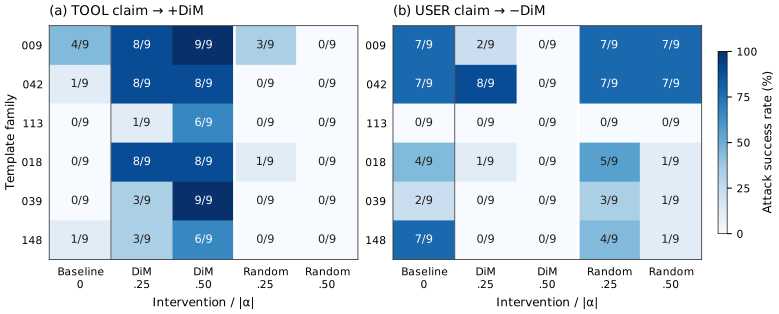
Using a similar approach to Steering Role Confusion and CounterSteer, we took six pairs of USER/TOOL declaration templates and applied DiM steering. It mostly worked. However, most USER-declared trajectories were successful, so the effect cannot be attributed to a role/label direction.
2.2 DiM on Templates with Reversed Success Rates
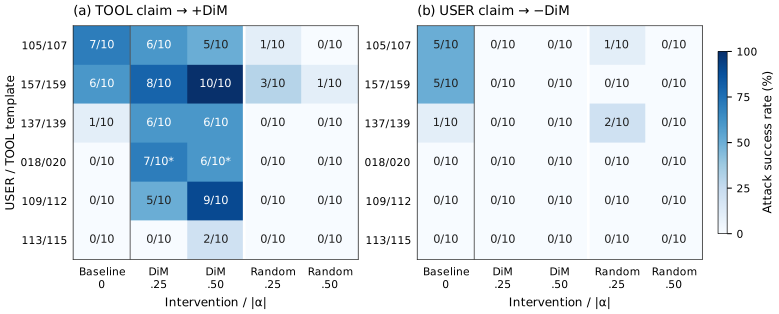
We then selected templates where the success rate under a TOOL declaration was higher than or equal to that under a USER declaration.
For the second pair (157/159), the USER declaration had fewer baseline successes than the TOOL declaration (5/10 vs. 6/10). Yet adding the USER−TOOL DiM direction to the TOOL-declared injections increased successes to 8/10 at α=0.25 and 10/10 at α=0.5. For the fifth pair (109/112), neither declaration had any baseline successes, but the same intervention at α=0.5 produced 9/10 successes.
Although only the role declaration changed, I think this result can only serve as a reference, because the selection introduces a prior distribution.
2.3 Label DiM
We computed activation differences of means for the probe's neutral text in different role blocks. This is still a DiM method, but the direction is computed from the activations used to train the probe, rather than from the probe's learned coefficients. In a small-scale test, we found that the directions were stable, but steering left the results largely unchanged.
| Direction | USER claim: baseline → steer | TOOL claim: baseline → steer | Train–held-out cosine |
|---|---|---|---|
| Bare label DiM | 10/10 → 10/10 | 2/10 → 1/10 | 0.964 |
| Prefix label DiM | 10/10 → 10/10 | 2/10 → 1/10 | 0.971 |
2.4 Probe Steering
We use the coefficients of a probe trained on neutral text as steering directions. The method and results follow below.
3. Prefix: Hypothesis and Method
Hypothesis: What the model learns and uses is a label-template protocol, with certain fixed or common label orders. Its representation and processing of roles/labels may therefore involve preceding labels. A label direction extracted from a bare role block may miss this information, leading to poor probing and steering results.
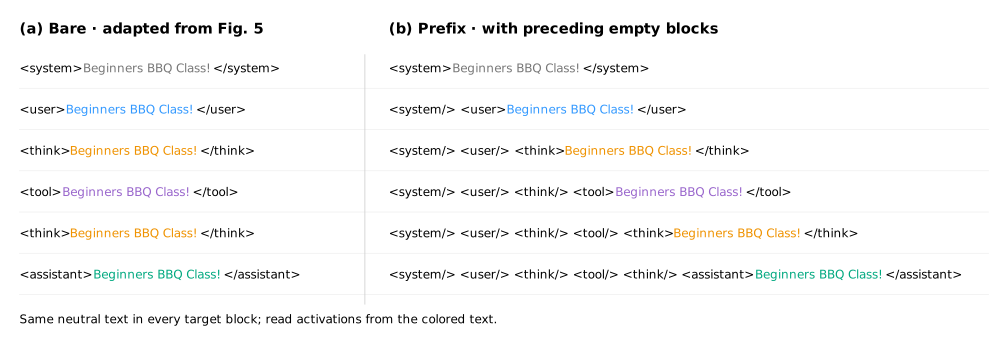
Method: Before the neutral text used to train the original probe, we add all preceding label blocks, with empty contents. The direction is therefore still extracted from labels. In the figure below, this means adding the sequence of label control tokens that precedes the target block in the template to the original construction on the left.
4. Results
4.1 Probing Benign Baselines
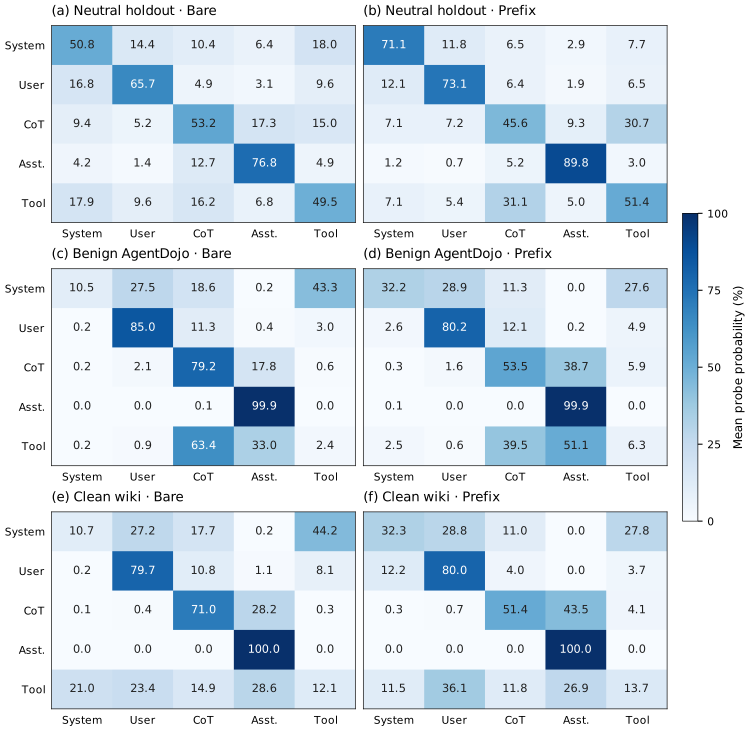
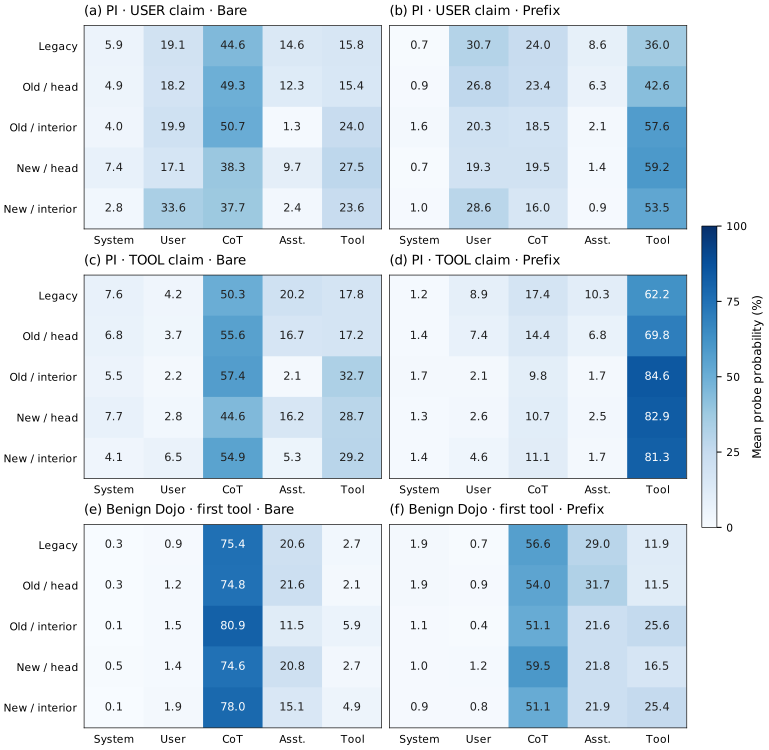
For GPT-OSS-20B, we evaluated a neutral held-out set, benign AgentDojo tasks, and the benign baseline of the PI task: summarizing wiki pages without the injection. Both methods read out tool reasonably well on the held-out set, but poorly on Dojo and PI.
4.2 Original PI Dataset
We use the 51 USER-declaration templates from the full template set and their 51 paired TOOL-declaration templates, with 10 webpages per template.
Probe. With role declarations and injected content, probing at the injection position gives much stronger readouts with prefix than with bare.
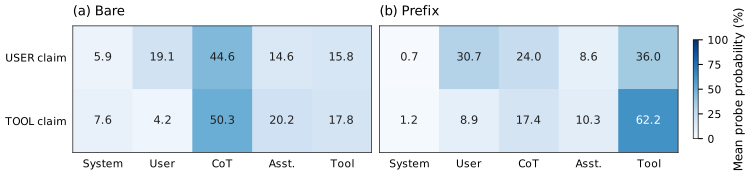
Steer. On the original PI dataset, using GPT-OSS-20B and USER declarations only, both prefix and bare user directions steer PI attack success rate (ASR) fairly effectively, with bare performing better. The prefix tool direction also steers effectively, whereas the effect of the bare tool direction is unclear: −tool decreases ASR.
| Probe | +tool | -tool | +user | -user |
|---|---|---|---|---|
| Bare | 61.18% (−6.27 pp) | 63.33% (−4.12 pp) | 85.29% (+17.84 pp) | 26.47% (−40.98 pp) |
| Prefix | 19.80% (−47.65 pp) | 83.33% (+15.88 pp) | 81.37% (+13.92 pp) | 38.04% (−29.41 pp) |
4.3 Dojo PI Dataset
The Dojo PI dataset contains 180 attack test combinations from CounterSteer's artifact repository.
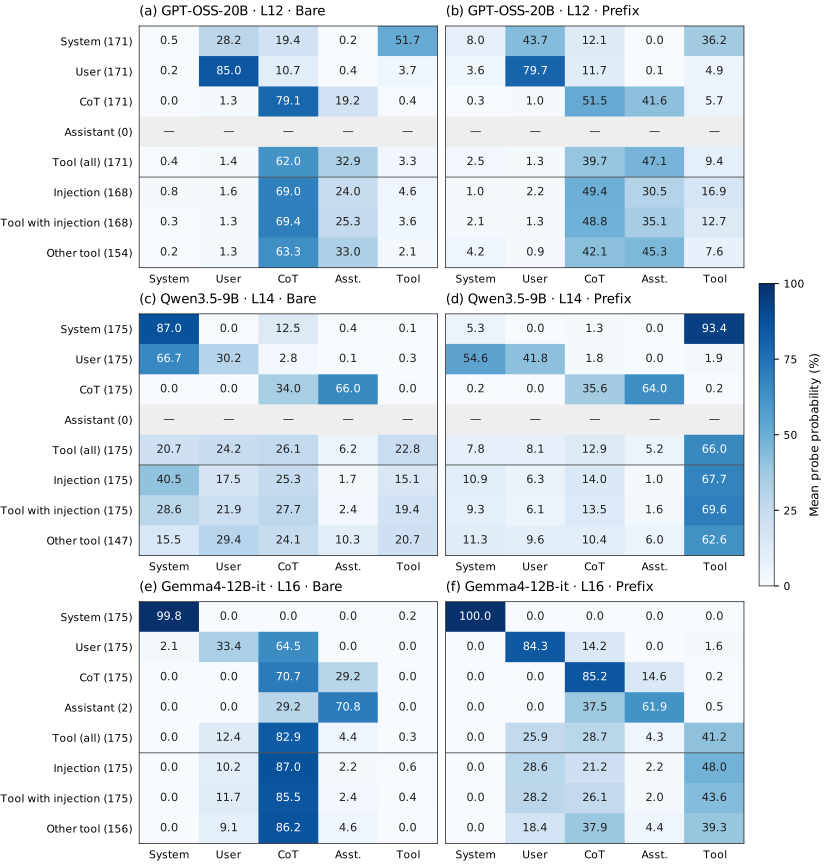
Probe. We compare bare and prefix on GPT-OSS, Qwen, and Gemma. On GPT-OSS, both methods still give weak tool readouts, consistent with the benign baselines for the original PI task and Dojo. On Qwen and Gemma, prefix noticeably improves tool readouts.
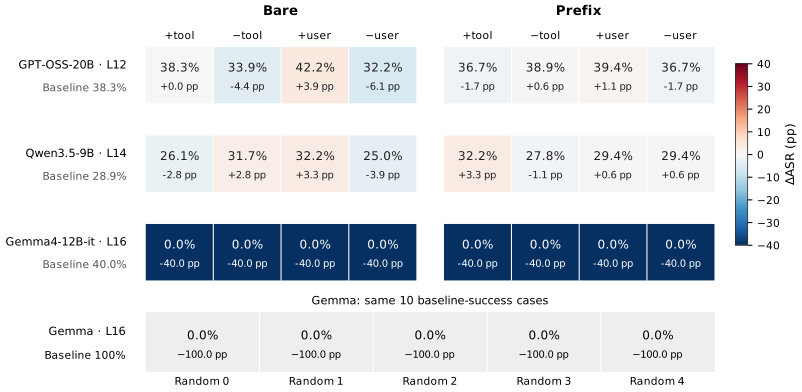
Steer. For GPT-OSS and Qwen, steering effects are weak for both bare and prefix, and prefix performs worse than bare. For Gemma, steering in any of the ±user/tool directions makes all attacks fail, as do the five random directions tested. After steering, Gemma's legitimate-task success rate under attack (AgentDojo's native utility evaluation) increases by 5.6–13.9 percentage points. The mechanism here is unclear.
5. Discussion and Summary
For GPT-OSS, tool readouts are poor on the benign baseline of the original PI task, yet the original PI task can be steered. Tool readouts are also poor on Dojo PI, but it cannot be steered. For Qwen and Gemma, ASR on the original PI task is too low to serve as a baseline. On Dojo PI, tool readouts improve noticeably for both models, but their steering results are completely different.
These results show a substantial mismatch between role-direction readouts and intervention effects. Bare and prefix behave similarly in this respect.
Overall, prefix yields better tool probing and steering directions on the original PI dataset. However, (1) the effects depend on the dataset, (2) results vary greatly across models, and (3) prefix has no general advantage over bare.
6. Next Steps
7. Other Results
7.1 Correlation Between Probe Readouts and ASR
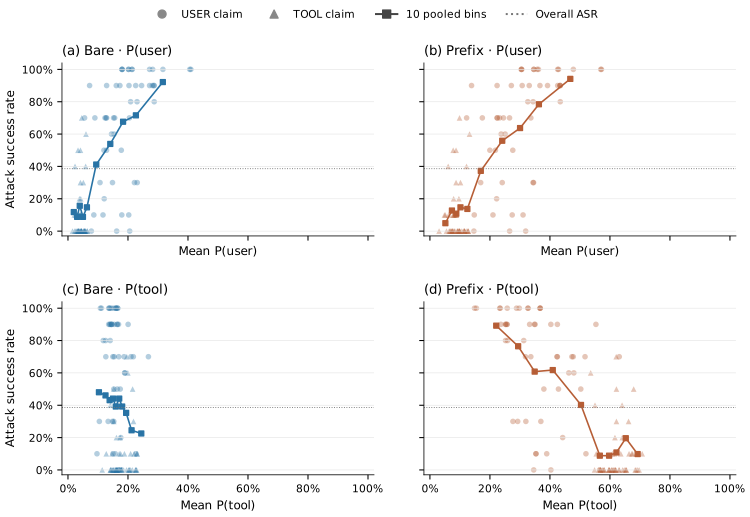
The tool direction found by the original method already shows some correlation with ASR.
7.2 Sensitivity to Neutral Training Text
The probe is sensitive to how the neutral text is sampled. On PI and benign Dojo with GPT-OSS, tool readouts vary by 10–20%. This may be related to length.
References
- Charles Ye, Jasmine Cui, Dylan Hadfield-Menell. Prompt Injection as Role Confusion. ICML 2026. The left panel of our Figure 3 is redrawn from Figure 5 of arXiv v6.
- charles_ye, Jasmine C. A Mechanistic Explanation of Prompt Injection (and why you should study roles). LessWrong, 2026-06-22. Extended blog version of the original work.
- Owain Mogford. Role confusion: sounding like the cause is indistinguishable from being it.. LessWrong, 2026-06-29.
- Kevin Zhang, Daniel Lee, Jaewoo Park. Steering Role Confusion. LessWrong, 2026-08-20.
- Mark Russinovich. CounterSteer: Suppressing Indirect Prompt Injection with Activation Steering. arXiv:2609.36570, 2026. Artifact repository.
- AgentDojo: official code and evaluation framework.